


Understanding the Basics of Derivatives
- samrudhlok8
- Apr 16, 2024
- 5 min read

What is derivative?
Derivatives are financial instruments that derive their value from an underlying asset or security. They are widely used in the financial markets for hedging, speculation, and arbitrage purposes. In this blog post, we will provide a basic understanding of four types of derivatives: options, futures, swaps, and forwards.
Types of derivatives:
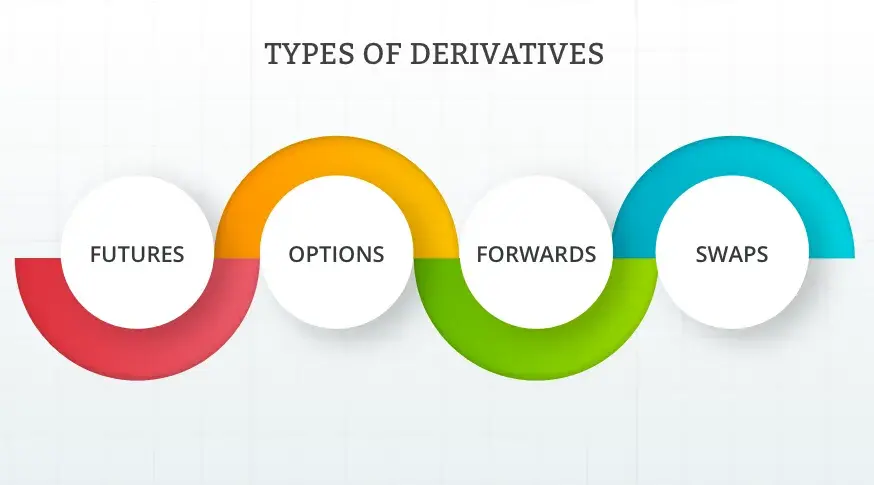
1. Options:

Options give the holder the right, but not the obligation, to buy or sell an underlying asset at a predetermined price within a specified time period. There are two types of options: call options and put options. Call options give the holder the right to buy the underlying asset, while put options give the holder the right to sell the underlying asset. Options provide flexibility and can be used for hedging against price fluctuations or for speculative purposes.
Example: Imagine you want to buy a house, but you're not sure if you'll have enough money to do so in six months. You find a house you love and want to secure the option to buy it at the current price, but you're not ready to commit to purchasing it just yet.
So, you approach the homeowner and propose an option agreement. You offer to pay them a fee of $500 for the option to buy the house at the current price of $200,000 within the next six months.
Here's how the option works:
You pay the homeowner $500 for the option.
This gives you the right, but not the obligation, to buy the house for $200,000 within the next six months.
If, after six months, you decide not to buy the house, you simply let the option expire. You've lost the $500 fee, but you're not obligated to buy the house.
However, if after six months the house has appreciated in value and is now worth $220,000, you can still buy it for the agreed-upon price of $200,000. You've effectively profited $19,500 ($220,000 - $200,000 - $500).
In summary, options give you the flexibility to buy or sell an asset at a predetermined price within a specified time frame, without obligating you to do so. They can be used for various purposes, including speculation, hedging, and risk management.
2. Futures:
Futures contracts are agreements to buy or sell an underlying asset at a predetermined price on a future date. Unlike options, futures contracts are binding and both parties are obligated to fulfil the contract. Futures are commonly used for hedging against price volatility and for speculation. They are traded on organized exchanges and are standardized in terms of contract size, expiration date, and delivery terms.

Example: Imagine you're a farmer who grows wheat. You anticipate that you'll have a large harvest in three months, but you're worried about the price of wheat dropping by then. You want to lock in a good price now to protect your profits.
So, you decide to enter into a futures contract with a buyer. You agree to sell 1,000 bushels of wheat to the buyer at $5 per bushel in three months' time.
Here's how the futures contract works:
You and the buyer agree on the terms of the contract: 1,000 bushels of wheat at $5 per bushel, to be delivered in three months.
You're obligated to deliver the specified amount of wheat at the agreed-upon price on the specified date, regardless of the current market price of wheat at that time.
Similarly, the buyer is obligated to purchase the wheat from you at the agreed-upon price, even if the market price has risen above $5 per bushel.
If, after three months, the market price of wheat has fallen to $4 per bushel, you still sell the wheat for $5 per bushel as per the contract. In this case, you've effectively profited $1 per bushel, or $1,000 in total.
On the other hand, if the market price of wheat has risen to $6 per bushel, you're still obligated to sell it for $5 per bushel. In this case, you've missed out on potential profit, but you've protected yourself from the risk of the price dropping.
In summary, futures contracts allow parties to lock in prices for the future delivery of an asset, providing both buyers and sellers with price certainty and a way to hedge against price fluctuations.
3. Swaps:

Swaps are agreements between two parties to exchange cash flows or other financial instruments. The most common type of swap is an interest rate swap, where parties exchange fixed and floating interest rate payments. Swaps are used to manage interest rate risk, currency risk, and credit risk. They are customizable and can be tailored to meet the specific needs of the parties involved.
Example: One party may have a fixed-rate loan while the other has a variable-rate loan. They agree to exchange payments, with one paying a fixed rate and the other paying a floating rate based on an agreed-upon notional amount. This allows them to hedge against interest rate fluctuations or meet specific financial needs. For instance, one party gains stability with fixed payments while the other gains flexibility with variable payments. Swaps enable parties to customize their debt management strategies effectively.
4. Forwards: Forwards are similar to futures contracts, but they are traded over-the-counter (OTC) and are not standardized. In a forward contract, two parties agree to buy or sell an underlying asset at a future date and at a price determined at the time of the agreement. Forwards are used for hedging and speculation, and they offer more flexibility compared to futures contracts.

Example: Imagine you're a farmer expecting to harvest 1,000 bushels of corn in six months. You're concerned about the fluctuating market price of corn and want to secure a favorable price now. On the other hand, there's a cereal company looking to buy corn for its production needs in six months.
You and the cereal company agree on a forward contract. You agree to sell 1,000 bushels of corn to the cereal company at $4 per bushel in six months' time.
Here's how the forward contract works:
You're obligated to deliver 1,000 bushels of corn to the cereal company in six months at the agreed-upon price of $4 per bushel, regardless of the market price at that time.
The cereal company is obligated to buy the corn from you at the agreed-upon price.
If, in six months, the market price of corn has risen to $5 per bushel, you still sell it to the cereal company for $4 per bushel as per the contract. In this case, you've effectively profited $1 per bushel.
Conversely, if the market price of corn has fallen to $3 per bushel, you still sell it for $4 per bushel. While you missed out on potential profit, you're protected from the risk of the price dropping.
In summary, forwards allow parties to lock in prices for the future delivery of an asset, providing both buyers and sellers with price certainty and a way to hedge against price fluctuations.


Comments